After the last post introduced the holy grail of version ranges for nixpkgs, @arianvp over X felt it was a doomed endeavor: “What happens when a plan spans revisions and you accidentally load two versions of the same library? DOOMED.” 💀
He was right to be skeptical. The diamond dependency problem is a truly nasty one. I am however determined to add enough safeguards to make it a safe endeavor. The first step is to make sure that the solver never produces a plan that mixes versions of the same library in one process image, when requested.
The general shape of the diamond problem: you link libfoo-2 and libbar-1, but libbar-1 links libfoo-1. Now your process carries both libfoos, and only one symbol can win.
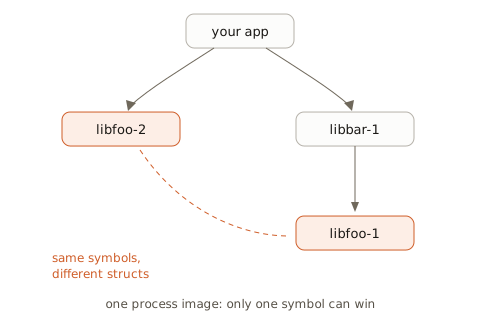
He provided an example that happened in Nixpkgs itself. fluent-bit vendored one zstd and linked against libsystemd, which dlopen another zstd for compressed logging. zstd is not ABI compatible across versions like glibc, so the two disagreed on struct layout, and logging corrupted the address space. Two versions of one library in one process is a crash. 💥11Turns out the bug is even more outlandish because fluent-bit vendored zstd itself breaking Nix’s ability to reason about the graph at all.
§Sidestepping the problem
Nixpkgs generally sidesteps this problem by virtue of its coherency philosophy: everything is built against a single revision so the diamond dependency problem generally does not arise.22The fluent-bit#10139 bug was itself an outlier within Nixpkgs. The problem arises when you deliberately mix revisions.
Nix itself however can support, and was designed for, multiple revisions across processes. Each binary points to its own libraries through the RUNPATH at the /nix/store/, and they never collide.
The problem is only exposed when we are deliberately mixing revisions in one process image. Within a ^ coexistence group, grail already dodges this problem by virtue of its design: it also
forces the attributes to be coherent to a single revision.
If you are using grail lock to import top-level binaries into your configuration, you are safe no matter what. This is what Nix was designed for!
If however you are using mkDerivation to build packages with attributes you locked, you might be mixing shared libraries across revisions, if you don’t force a coexistence group ^, and might have had a bad time. I have a solution for you below! 🙌
§Coherence constraints
The grail tool generalizes the glibc constraint from the last post to any library, and it turned out to need no new data at all.
The tool now supports a --one <attr> flag that demands every chosen revision fall in one era of the given attribute.
For instance, --one zstd demands every chosen revision picked to solve the query must have shipped the same zstd version. The solver will refuse to mix revisions that ship different versions of zstd, and will report exactly what would have mixed.
Here is the same query python3@3.10.* postgresql@13.* with and without --one zstd --one openssl. You can see that the solver picks versions of each such that there is only one zstd and one openssl version.
# free: python at its freshest, sixteen months after postgresql 13
# died. glibc is RESOLVED, not constrained: the newest spanned era
# serves every input via symbol versioning
$ grail solve 'python3@3.10.* postgresql@13.*'
2 revisions
  2022-05-20-dfd82985c273  (2022-05-20, r771)
    postgresql 13.6
  2023-10-19-7c9cc5a6e5d3  (2023-10-19, r1128)
    python3 3.10.12
  glibc: 2.37 serves every input (eras spanned: 2.34, 2.37)

# one zstd, one openssl: python retreats until every library agrees —
# and glibc lands on one era for free
$ grail solve 'python3@3.10.* postgresql@13.*' --one zstd --one openssl
2 revisions
  2022-05-20-dfd82985c273  (2022-05-20, r771)
    postgresql 13.6
  2022-06-26-f2537a505d45  (2022-06-26, r793)
    python3 3.10.4
  zstd: 1.5.2
  openssl: 1.1.1o
  glibc: 2.34
This causes the chosen python3 to retreat to an earlier revision to satisfy the zstd and openssl coherency.
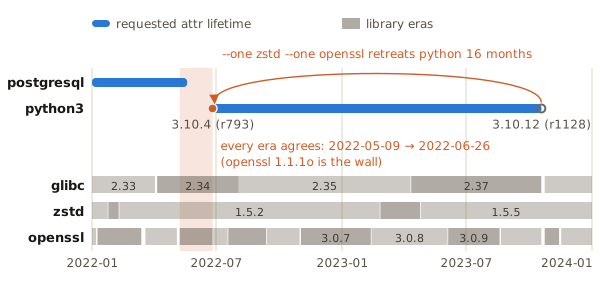
When no coherent plan exists, the solver names exactly what would have mixed:
$ grail solve 'ffmpeg@5.* nodejs@16.*' --one zstd --one openssl
unsatisfiable: satisfiable only by mixing zstd 1.5.2/1.5.5,
openssl 1.1.1q/3.0.10; --one forbids that
You can run these examples directly in the browser at fzakaria.github.io/grail which includes some precanned examples and the ability to select --one attributes.
The plan graph draws each library as its own node, so a coherent plan is visible at a glance: every revision converging on a single node per library.
§What it promises, and what it cannot
Precision matters here. --one zstd guarantees version-level ABI agreement: every chosen revision ships the same zstd version, so no plan can hand you a mix of two different versions.
It does not guarantee that they consolidate to the same commit or even /nix/store path. Two revisions can ship the same version as different rebuilds if anything in their closure changed
If you want to guarantee one path, you need to use ^ to force a single revision.
We can go even further too! Some libraries, notably glibc, have backwards compatibility guarantees across versions. The solver can reason about this and allow a plan to mix versions of glibc that are compatible, but not mix incompatible versions. That can make the solver much more flexible which is something I am keen to explore.
Building software always contains dragons, the only difference is our ability to reason through them. I am personally enjoying throwing a SAT solver at the problem and seeing what I can reliably cook up.