Exit 0 means your program exited 0. That’s it. That’s all it means. 🍞
I have been working on a deterministic VM called Rewind VM, where “a run” (i.e. test, command etc.) is a function of its inputs including the thread schedule. The determinism comes from the tool recording every step which lets you replay it exactly. This alone is a pretty good way to find flaky tests: run the test under Rewind, then rewind check runs it under many different thread schedules, with some slight latency added, and failures often crop up. 🐛
Feedback however was that it was not enough: the tool could find a failing schedule, but it could not tell you if that schedule was actually a bug. It only knew that the run ended differently than the original schedule, which could be a crash, a timeout, or just a different exit code. That is not enough to say “this is a bug”.
Someone pointed out that I had built most of a property-based testing tool, but I only had one property: matching exit codes.
What is property-based testing?
If you have used QuickCheck or Hypothesis, you have already used the idea. You write a property, or constraint, that must hold for every input. The tool generates lots of inputs, and when one breaks the property, it shrinks it down to the smallest input that still fails.
rewind check already did the generating and the shrinking. The inputs are thread
schedules, and narrowing shrinks a failing schedule down to the one step that causes the failure. The only property though was “the run ends the same way schedule 0 did”: the same exit code and the same outputs.
That’s a pretty low bar, but easy to improve. 🙃
Rewind now lets specify properties that must be true for every run, or must be true for at least one run, or must never be true in any run.

§Two tellers: Java Edition ☕
Let’s keep the bank from last time: two tellers deposit into one account from two threads, without a lock.
This time the example is in Java as a JUnit 5 suite to appeal to my Enterprise brethren.11It is bank-java in the Rewind repository, next to the C version.
void deposit(int teller, long amount) {
    long seen = balance;
    System.out.println("teller " + teller + ": " +
                        seen + " + " + amount);
    balance = seen + amount;
}
A teller that runs between the other’s read and store writes a stale balance over the other’s deposit. 💥
We include a “typical” test suite: one teller, two tellers concurrently, and a new account being empty. We run it and see all tests pass and head home for the day. 🍺
Is the code correct? Let’s use Rewind to dig further.
§Properties that come in the box
Before even looking at the balance, Rewind knows a lot about what a run did. Every open, write, rename, close, fork and exit is in the trace, with the step it happened at. Rewind ships properties computed from the trace alone:
| Property | A run violates it when |
|---|---|
no-crash |
a process dies of a signal such as SIGSEGV, even if a retry hid it |
no-orphans |
a process the job started is still running when the job exits |
single-writer=GLOB |
two processes have a matching file open for writing at once |
atomic-replace=GLOB |
a matching file is truncated in place instead of renamed over |
no-read-while-written=GLOB |
a matching file is opened for reading while another process writes it |
writes-within=DIR:DIR |
the job writes outside these directories |
junit=GLOB |
a test that passed on schedule 0 fails, by the JUnit XML reports |
script=PATH |
a program of yours exits 1 |
Let’s throw a few at the bank and only run schedule 0:
$ rewind check --schedules 0 --property no-crash --property no-orphans \
    --property 'writes-within=/build' github:fzakaria/rewindvm#bank-java
schedule   0: exited:0     148479 steps  ba3f68ae3869  run bd3b527f0a837af8  violates writes-within
  writes-within: step 2710: process 111 (javac) opened /tmp/hsperfdata_nixbld/111 for writing, outside /build
never true in any run: sometimes "deposits-concurrent"
every schedule violated a property, as schedule 0 did
Interesting! javac writes its performance counters to /tmp/hsperfdata_<user>/<pid>22-XX:-UsePerfData turns it off. . It has nothing to do with our bug, but I included it because I learned something new and it could have been a bug if it did not include the process ID.
The file properties shine for bugs between processes. The
properties tutorial has a program that
rewrites its config in place while another process rereads it. Its own test fails only
when a read lands between the truncate and the last write, but atomic-replace flags it on
the very first run. 😲
§Asserting from the inside
The bank’s real invariant is not in any syscall though. It lives in memory in our example: the balance variable must add up.
For that there is the Rewind SDK, a tiny library you call from your program. Each call
writes one line to /dev/rewind, a device in Rewind’s VM, and the trace keeps it with the
step, process and thread that wrote it.33Outside Rewind the device does not exist and every call does nothing, so the calls can stay in your code.
// Account.deposit: another teller is mid-deposit.
int others = depositing.getAndIncrement();
Rewind.sometimes(others > 0, "deposits-concurrent");

// BankTest.twoTellersDeposit
Rewind.always(balance == expected, "balance-adds-up",
        () -> "balance " + balance + ", expected " + expected);
always must be true every time the program reaches it. unreachable is its opposite: a run that reaches it at all fails. These are your typical assertions, except we get the whole replay if it fails.
sometimes is the one I find the most interesting and tough to think through at times. 🤓 It tests the search: its condition must be true in at least one of the runs check tries, and it never fails a run. In model-checking terms, always is a safety property (nothing bad happens in any run) and sometimes is a reachability property (some run gets there). Here it asks whether any run had both tellers inside deposit at the same time.
Look at the output above again:
never true in any run: sometimes "deposits-concurrent"
The suite passed under schedule 0, but one teller always finished its deposit before the other started. That pass told us nothing about the race. 🤷

Let check try its default 64 schedules:
$ rewind check github:fzakaria/rewindvm#bank-java
...
true in 11 of 17 runs that checked it: sometimes "deposits-concurrent"
...
step 145417 decides it: a reschedule and a 10 µs stall there makes the run violate same-outcome, sdk

passing: run 61643f768ec51337, schedule 2 over steps 144694..145417
failing: run 643a298ef0ec3f7b, schedule 2 over steps 144694..145418
the two are the same run until step 145417
failing run violates same-outcome: step 149407: ended exited:2, where bd3b527f0a837af8 ended exited:0
failing run violates sdk: step 145713: always "balance-adds-up" failed: balance 380, expected 400
That took 40 seconds on my laptop44The JVM is chatty: 148,479 steps for three tests, where the C equivalent takes about 4,500. and we found that two deposits went missing.
The first line is the sometimes again: of the 17 runs check tried before it found the
failure, 11 had both tellers inside deposit at once.
§Did I truly fix it?
The fix is the obvious one: hold a lock from the read to the store.
int others = depositing.getAndIncrement();
Rewind.sometimes(others > 0, "deposits-concurrent");
synchronized (lock) {
    long seen = balance;
    System.out.println("teller " + teller + ": " +
                        seen + " + " + amount);
    balance = seen + amount;
}
depositing.decrementAndGet();
$ rewind check .#bank-java
...
true in 42 of 65 runs that checked it: sometimes "deposits-concurrent"
every property held under all 65 schedules
Every schedule passes, but is that enough to make us feel warm and fuzzy?
The sometimes line is what gives me the warm embrace: in 42 of the 65 runs the tellers ran concurrently, but the lock prevented the bug. ✅55This counter must sit outside the lock. With synchronized void deposit, the second teller would wait before it reaches the counter.
A condition that is only true when the bug happens can never be true once the bug is fixed. 💡
§JUnit
Java developers though love writing JUnit tests. Fear not my FizzBuzzEnterprise colleagues, Rewind has you covered: the SDK has a JUnit 5 extension.
Put @ExtendWith(RewindExtension.class) on the test class and it marks each test’s start and result.
@ExtendWith(RewindExtension.class)
class BankTest { ... }
If you can’t touch the code, junit=GLOB reads the XML reports the runner wrote instead:
Maven’s surefire, Gradle, pytest’s --junitxml, whatever writes the format.
$ rewind check --property 'junit=TEST-*.xml' github:fzakaria/rewindvm#bank-java
...
step 145417 decides it: a reschedule and a 10 µs stall there makes the run violate junit, sdk
failing run violates junit: step 149407: test BankTest.twoTellersDeposit() passed in the unperturbed run and failed here
failing run violates sdk: step 145713: always "balance-adds-up" failed: balance 380, expected 400
§Visualizing properties
The Rewind app shows the timeline of a run, with the tests and the build log. The failing test is red, and the event card names the assertion that failed.
$ rewind open 643a298e 145713 --compare 61643f76
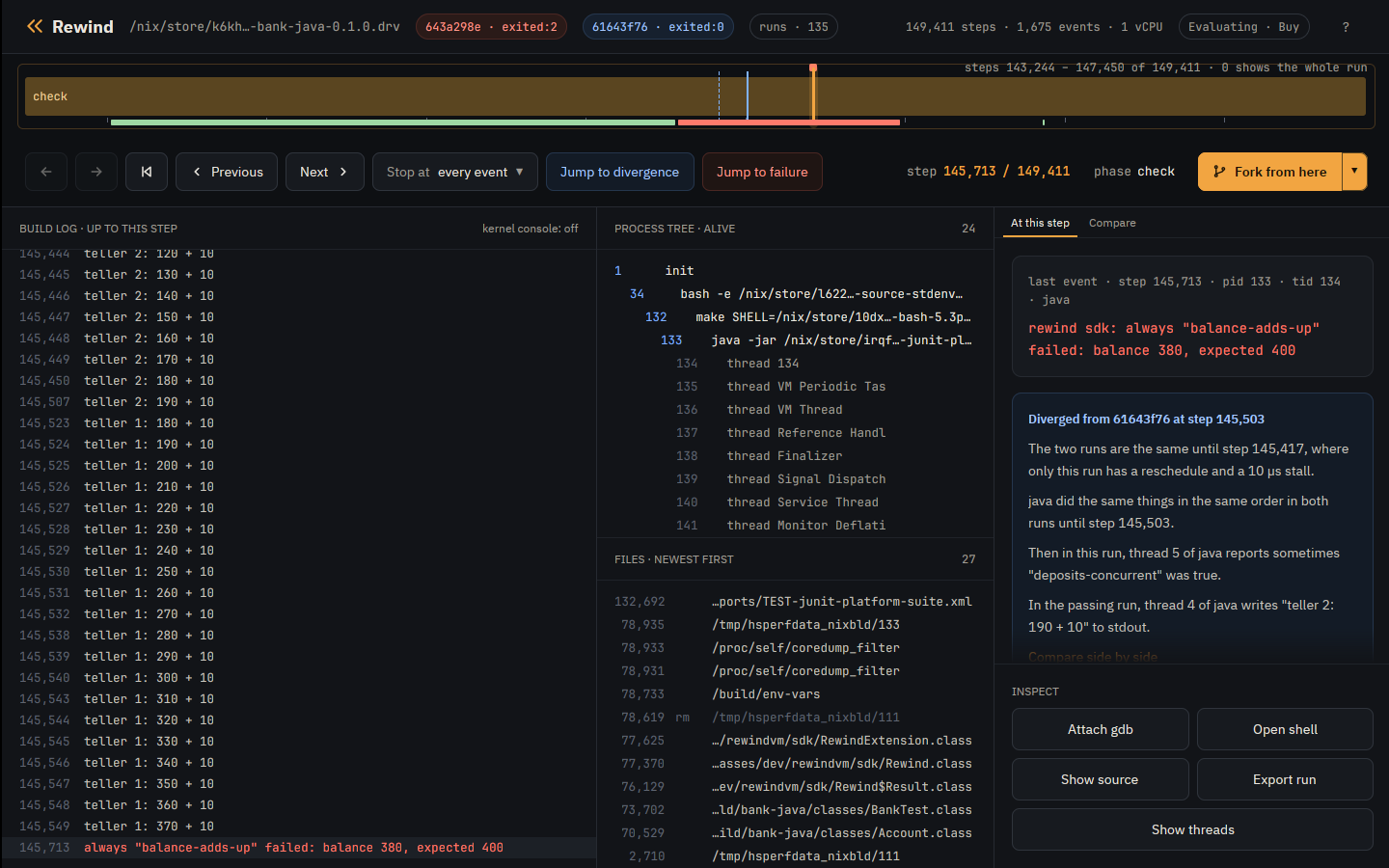
The strip under the timeline has a span per test: green passed, red failed. Each include a helpeful tooltip with the test name and the steps it ran.

All the other Rewind features can then be used to help isolate the cause: the source panel, gdb on a fork at any step, the thread lanes and Check from here.
§Easy Peasy ?
There is a SDK for many languages already included in the Rewind repository. They are tiny, and the only dependency is the Rewind VM itself. The SDK is a single file or two per language, and you can copy it into your project.66The SDK’s README has the format instrunctions if you want to write one for another language.
- C and C++:
rewind.h,REWIND_ALWAYS(cond, "id", "fmt", ...) - Rust:
rewind_sdk::always!(cond, "id", "fmt", ...) - Go:
rewind.Always(cond, "id", "fmt", ...)andrewind.Track(t)forgo test - Python:
rewind_sdk.always(cond, "id"), and a pytest plugin that loads itself - Java:
Rewind.always(cond, "id")and the JUnit 5 extension - Shell:
rewind_always id "message" test "$x" -eq 3
$ curl -fsSL https://rewindvm.dev/install | sh
$ rewind check github:fzakaria/rewindvm#bank-java
The properties tutorial goes through each piece step by step, and the advanced tutorial has script properties and a file of properties to keep beside your tests for the more adventurous.
If you happen to find any interesting bugs with Rewind let me know. I am keeping track of a small leaderboard of the best ones. 🏆