The advent of large language models has changed the economics of closing gaps in software stacks.
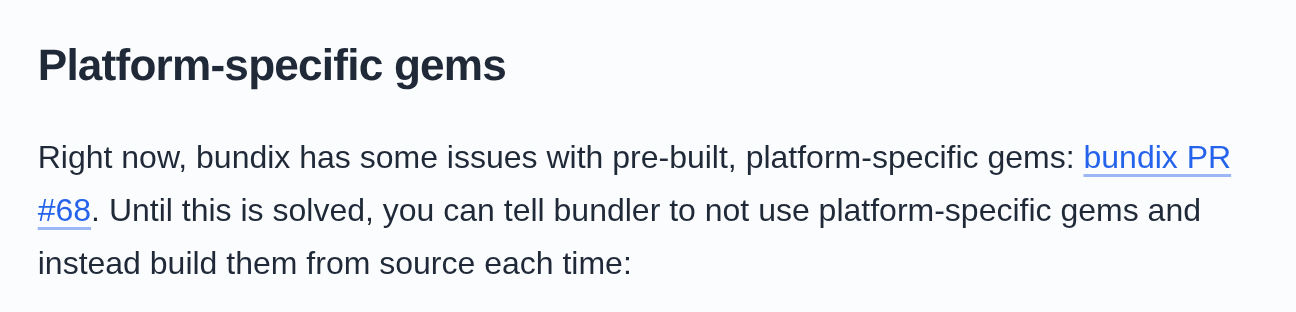
This is in the nixpkgs manual, in the Ruby section, under “Platform-specific gems” [ref]. The pull request (PR#68) it points to was opened in October 2019 and closed, unmerged, in August 2026, with: “Closing as stale. I no longer work with bundix. Feel free to take it over.” [cite]
Aside There are alternatives that have sprung up but they all have unique gaps or are not widely communicated as blessed solutions. The manual itself also does recommend a workaround for the issue, but in practice I found it to not work in practice.
Every ecosystem has gaps everyone has learned to step around. They survive because there is just too much stuff to do. We live with these warts and gaps because the cost of fixing them is either too high or there are more important things to do.
That economics is gone.

We can have and expect amazing perfectly correct software stacks, because the cost of fixing gaps is now low enough that it is worth doing. The economics of software have changed.
The multiple days of typing are now an afternoon, or less, of directing and reading to an AI agent. In the case of Nix and Ruby, I wrote the Nix side of a Bundler lockfile solution, gemlock.nix, within an hour, removing days of misery I hit while running this blog.
While AI generated code may suffer from slop, it is a growing skill how to wield AI to produce correct verifyable code. Nix is amazingly well-suited as it gives the agents a reproducible test-bed with which to verify the correctness of the code they produce.
The economics of software have changed, and we can now expect to have no quarter for gaps in our stacks.