I remember having a chat with @siggisim, BuildBuddy co-founder, that what made Bazel special at Google was not necessarily its technological-chops but rather Google’s monorepo (/google3/) and their strict requirement that all third-party software be built and managed within that monorepo by Bazel.
Bazel has gotten a lot wider adoption outside of Google in recent years, especially with the increase code-authoring that has been ushered in by large language models. Although some package-specific libraries have made their way into the Bazel Registry, the majority of third-party software is still hand-rolled for Bazel repeatedly by each organization or developer.
I asked @siggisim, “Why is there no global monorepo for third-party software like Google has with /google3/third_party?”
The closest thing to such a global monorepo for third-party software is Nixpkgs, but it is not for Bazel. 😈
In Build systems à la trace I recorded a Nix build with Rewind and transpiled the recording into Bazel genrules with the output being bit-for-bit identical to what Nix would have produced.
Aside There was a slight cheat in the approach. Every rule ran in a sandbox that mounted the host’s
/nix/store. GCC, glibc and zlib were just there. Bazel had no idea where they came from, so each converted package was an island.
The month prior I compiled all of nixpkgs to TypeScript because any alternative Nix language needs to interop with twenty years of work encapsulated in nixpkgs to be useful.
What happens if I do the same but for Bazel?
What if I point genrulify at Nixpkgs and create the largest Bazel workspace of genrules ever?
tl;dr I have created the largest Bazel workspace of
genrules ever. fzakaria/genrulify-nixpkgs is a transpiled version of Nixpkgs into Bazelgenrules. At the moment it contains 219 packages as 2,386genrules as a demonstration of the approach.
§Mass converting nixpkgs
Originally genrulify sandbox mounted the host’s /nix/store, and Bazel never actually had to manage the dependencies of GCC or glibc. To support many packages in one workspace, each store path has to be a proper Bazel target.
The recorded commands still use absolute paths though and this cannot change. The binaries have the /nix/store embedded in the RUNPATH and so forth, the binaries are not yet relocatable.
cc_object(
    name = "s10006_gcc",
    src = ":s1268_tar/build/zlib-1.3.2/compress.c",
    out = "s10006_gcc/build/zlib-1.3.2/objs/compress.o",
    data = [":closure", "//genrulify:sandbox.sh", ...],
    cmd = [
        # …
        "/nix/store/xg9jq55q…-xgcc-16.2.0/bin/gcc -fPIC -O2 … -c -o objs/compress.o compress.c",
    ],
)
We still rely on Bazel to bind-mount the store paths at their expected locations in /nix/store before running the recorded commands, however the paths are now proper Bazel targets rather than relying on the host’s store. The host’s store is no longer mounted.
:closure lists every store path the command could read:
filegroup(
    name = "closure",
    srcs = [
        "//store/xg9jq55qj9k603jabx1j5wwsgq7ma1bq-xgcc-16.2.0:path",
        "//store/h4wfwic161kxrr74jlzla5lsm28hgary-glibc-2.44-25:path",
        "//store/10dxp0qxqxxsyiljrh2kp0xqhz6arhcx-bash-5.3p15:path",
        # …
    ],
)
Aside Unpacking a compiler for every action would cost more than the action. The sandbox script unpacks a NAR once into
/var/tmp/genrulify-store-$UID/<sha256 of the NAR>and bind-mounts it at its/nix/storename. So Bazel ends up with a content-addressed store that it mounts at input-addressed paths, which is the intensional model again, by accident.
To support partial migration, the workflow separates the conversion of individual packages from the linking of the entire workspace. This allows one to incrementally convert packages to Bazel genrules without needing to have the entire workspace converted at once.
genrulify convert writes one package as pkgs/NAME/BUILD.bazel with no knowledge of other packages or the global store.
We then run genrulify link afterwards over the whole workspace to link all the converted packages together.
We convert each package to one of the following types:
- A package in the workspace builds it, and the result matches the cache:
nix_built. - cache.nixos.org has it:
nix_fetched. - Neither. The NAR is packed from the local store and checked in:
nix_source.
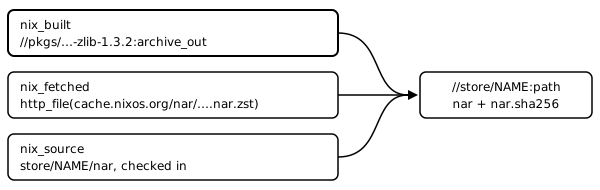
Having a hermetic C++ toolchain as part of the build process is now trivial.
# MODULE.bazel
http_file(
    name = "nar_5q6bdxkp7lc70gn9mnf4yiybrx8ry5xq",
    sha256 = "62a323202e2a0b91528b63359e8f9d12d2a1fcb74f14cd49a6fce2ec6192d2d4",
    urls = ["https://cache.nixos.org/nar/0z42bz5lk01cc8zyar0n1gb0s8rg139gqg0h7pz4ci5kqh784dms.nar.zst"],
)

# store/5q6bdxkp7lc70gn9mnf4yiybrx8ry5xq-gcc-16.2.0/BUILD.bazel
nix_fetched(
    name = "path",
    src = "@nar_5q6bdxkp7lc70gn9mnf4yiybrx8ry5xq//file",
    compression = "zstd",
    sha256 = "ba36820ec4b34446fe3d103cfcd2082f230dd60b1664e53f622c8049cb5f827c",
)
The http_file hash is of the compressed download. The nix_fetched hash is of the NAR inside it.
The above is how GCC is converted and linked into the workspace. The Bazel community has spent a decade trying to achieve hermetic C++ toolchains, and for Nixpkgs it is table stakes.

§Why not all 74,957
Why did I only convert a subset of the 74,957 top-level derivations in Nixpkgs?
Because it is slow. I need more compute. 🤦
genrulify works by running the build in Rewind and forking the VM at each command to inspect the process and its filesystem, nine forks per command. Each fork takes 0.3 to 2 seconds depending on load, so the run converts about 70 derivations an hour on my machine.
All of nixpkgs at that rate is at least 45 days on one machine. 🙁

§Is this useful?
Did I actually build the world’s largest Bazel workspace? No.
Did the exploration though yield any insights? Yes.
Converting many packages revealed patterns and behaviors that were not obvious from individual derivations.
-
Bazel builds less than Nix would. Many packages only need a subset of their dependencies’ commands to run, and Bazel only executes those. Having a finer granularity of execution allows Bazel to skip unnecessary work. 💪
-
Derivations are no longer the smallest unit of work. A single derivation can be split into multiple actions that Bazel schedules independently.
One honest challenging gap is that actions in Bazel are meant to be bit-reproducible by design, otherwise all caching benefit breaks. Since Nixpkgs does not enforce or guarantee bit-reproducibility, converting certain Nix derivations may cause Bazel actions to produce different outputs and avoid early cutoff optimizations.
If we throw enough compute power at the problem, and fix the non-bit-reproducible actions, Bazel could potentially build the entire workspace efficiently, leveraging its fine-grained scheduling and caching mechanisms.
What awaits us is the largest Bazel workspace ever constructed, in all its Nix glory.